


 June 19, 2026
  3 mins to read
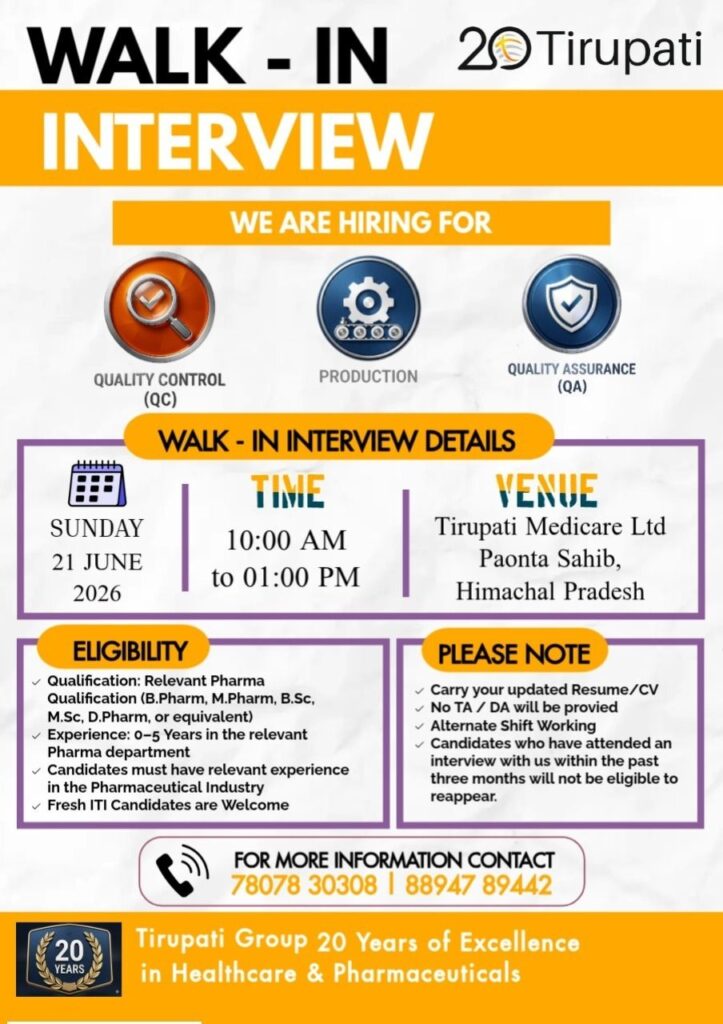
 Tirupati Medicare Ltd, a renowned pharmaceutical manufacturing company with over 20 years of excellence in healthcare and pharmaceuticals, has announced a Walk-In Interview Drive for Quality Control (QC), Production, and Quality Assurance (QA) departments. Candidates with relevant pharmaceutical qualifications and experience are invited to attend the interview and explore rewarding career opportunities in the pharma industry.
Company Overview
Tirupati Medicare Ltd is a leading pharmaceutical organization known for its commitment to quality, innovation, and regulatory compliance. The company specializes in manufacturing high-quality pharmaceutical products and offers excellent career growth opportunities for professionals in various functional areas.
Walk-In Interview Details
Particulars Details
Company Name
Tirupati Medicare Ltd
Departments
Quality Control (QC), Production, Quality Assurance (QA)
Interview Date
21 June 2026 (Sunday)
Interview Time
10:00 AM to 01:00 PM
Venue
Tirupati Medicare Ltd, Paonta Sahib, Himachal Pradesh
Experience Required
0–5 Years
Qualification
B.Pharm, M.Pharm, B.Sc, M.Sc, D.Pharm or Equivalent
Freshers Eligible
Fresh ITI Candidates Welcome
Eligibility Criteria
Candidates interested in attending the walk-in interview should meet the following requirements:
B.Pharm, M.Pharm, B.Sc, M.Sc, D.Pharm, or equivalent qualification.
0 to 5 years of relevant pharmaceutical industry experience.
Candidates must possess knowledge related to their respective departments.
Fresh ITI candidates are also eligible to apply.
Good understanding of GMP and pharmaceutical manufacturing practices will be preferred.
Departments Hiring
Quality Control (QC)
Responsibilities may include:
Raw material, in-process, and finished product testing.
Instrument handling such as HPLC, GC, UV Spectrophotometer.
Documentation and analytical data review.
Stability sample analysis.
Compliance with cGMP and GLP guidelines.
Production
Responsibilities may include:
Manufacturing operations as per SOPs.
Equipment operation and process monitoring.
Batch manufacturing documentation.
Maintaining productivity and quality standards.
Following safety and GMP requirements.
Quality Assurance (QA)
Responsibilities may include:
Batch record review and approval.
Investigation of deviations and CAPA implementation.
Documentation control and compliance monitoring.
GMP audits and quality system management.
Ensuring regulatory compliance.
Important Instructions
Candidates should note the following:
Carry an updated Resume/CV.
No TA/DA will be provided for attending the interview.
Alternate shift working may be required.
Candidates who attended an interview with Tirupati Medicare Ltd within the last three months are not eligible to reappear.
Contact Information
For additional information, candidates may contact:
📞 78078 30308
📞 88947 89442
Why Join Tirupati Medicare Ltd?
Work with a reputed pharmaceutical organization.
Exposure to regulated manufacturing environments.
Career growth opportunities in QA, QC, and Production.
Professional development through industry-standard practices.
Dynamic and quality-focused work culture.
Technical FAQs
1. What is the difference between Quality Assurance (QA) and Quality Control (QC)?
Quality Assurance focuses on preventing quality issues by implementing systems, procedures, and compliance measures, whereas Quality Control focuses on testing and verifying the quality of raw materials, intermediates, and finished products.
2. Which analytical instruments are commonly used in a QC laboratory?
QC professionals frequently use HPLC, GC, UV-Visible Spectrophotometer, FTIR, Dissolution Apparatus, and Karl Fischer Titrator for pharmaceutical analysis.
3. What is cGMP in the pharmaceutical industry?
Current Good Manufacturing Practices (cGMP) are regulatory guidelines that ensure pharmaceutical products are consistently produced and controlled according to established quality standards.
4. What is CAPA in Quality Assurance?
CAPA stands for Corrective and Preventive Action. It is a systematic approach used to investigate deviations, identify root causes, implement corrective measures, and prevent recurrence.
5. What documents are important during pharmaceutical production?
Key production documents include Batch Manufacturing Records (BMR), Batch Packing Records (BPR), SOPs, Equipment Logbooks, Cleaning Records, and Deviation Reports to ensure traceability and compliance.
Leave a Comment