

 July 11, 2026
  5 mins to read
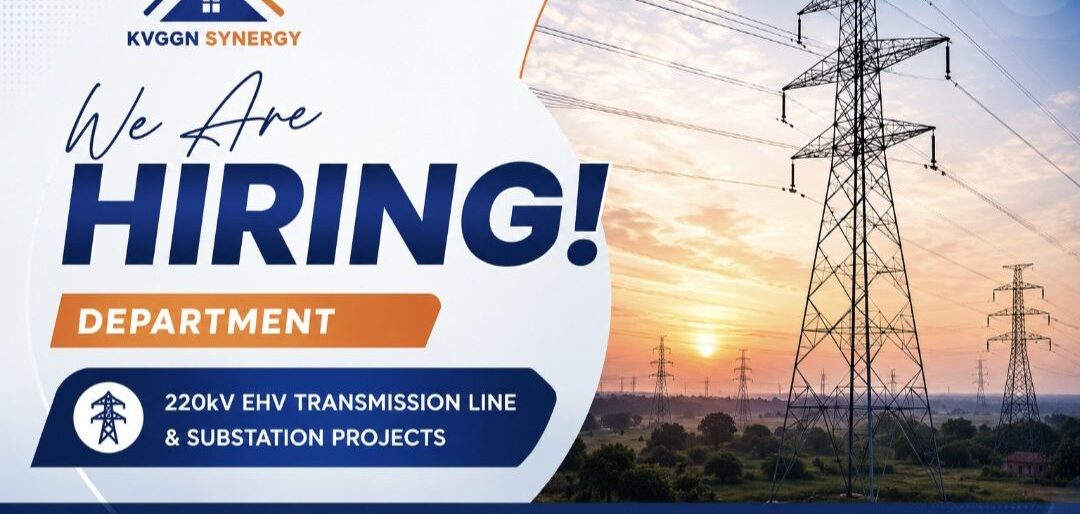
 KVGGN Synergy has announced a new recruitment opportunity for experienced Electrical Engineers interested in working on large-scale 220kV EHV Transmission Line and Substation Projects. The company is inviting applications from candidates with relevant qualifications and 2–4 years of industry experience.
The selected candidate will work at project sites in Bikaner, Rajasthan, and will be involved in the execution, supervision, testing, commissioning, safety, quality, and successful completion of EHV transmission projects.
Candidates with experience in Renewable Energy, Power Transmission, and EPC projects can review the complete eligibility criteria, responsibilities, required skills, and application process below.
KVGGN Synergy Recruitment Overview
Particulars Details
Company Name
KVGGN Synergy
Job Position
Electrical Engineer
Department / Project Area
220kV EHV Transmission Line & Substation Projects
Qualification
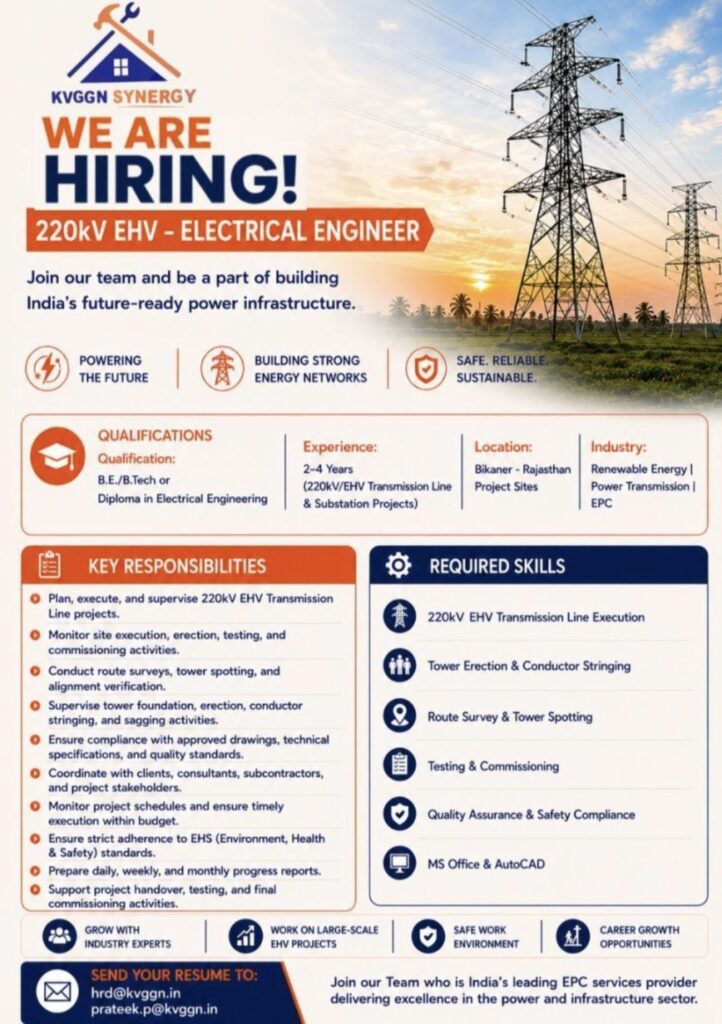
B.E./B.Tech or Diploma in Electrical Engineering
Experience Required
2–4 Years
Job Location
Bikaner, Rajasthan Project Sites
Industry
Renewable Energy, Power Transmission & EPC
Application Mode
Email Application
Experience Area
220kV/EHV Transmission Line & Substation Projects
About the Job Opportunity
KVGGN Synergy is looking for qualified and experienced Electrical Engineers to support the execution of 220kV Extra High Voltage (EHV) transmission infrastructure projects.
The position requires candidates who understand transmission line construction, tower erection, conductor stringing, route surveys, tower spotting, testing, commissioning, quality assurance, and EHS requirements.
The role also involves coordination with clients, consultants, subcontractors, and other project stakeholders to ensure timely completion of projects according to approved drawings, technical specifications, safety requirements, and quality standards.
Educational Qualification
Candidates applying for the Electrical Engineer position should possess one of the following qualifications:
B.E./B.Tech in Electrical Engineering or Diploma in Electrical Engineering.
Applicants should have the technical knowledge and practical experience necessary to work on EHV transmission line and substation projects.
Experience Requirements
Candidates should have 2–4 years of relevant professional experience.
Preference is given to applicants with hands-on experience in:
220kV/EHV Transmission Line Execution
Transmission Line and Substation Projects
Tower Foundation and Tower Erection
Conductor Stringing and Sagging
Route Survey and Tower Spotting
Testing and Commissioning
Quality Assurance and Safety Compliance
Key Responsibilities
The selected Electrical Engineer will be responsible for planning, execution, supervision, monitoring, and completion of 220kV EHV transmission line projects.
Major responsibilities include planning, executing, and supervising transmission line projects; monitoring site execution, erection, testing, and commissioning activities; conducting route surveys, tower spotting, and alignment verification; supervising tower foundations, tower erection, conductor stringing, and sagging activities; and ensuring compliance with approved drawings, technical specifications, and quality standards.
The engineer will also coordinate with clients, consultants, subcontractors, and project stakeholders, monitor project schedules to ensure timely execution within budget, ensure strict compliance with EHS (Environment, Health & Safety) standards, prepare daily, weekly, and monthly progress reports, and support project handover, testing, and final commissioning activities.
Required Technical Skills
Candidates should possess strong practical and technical knowledge of 220kV EHV Transmission Line Execution.
Important skills required for this position include tower erection and conductor stringing, route survey and tower spotting, testing and commissioning, quality assurance and safety compliance, and proficiency in MS Office and AutoCAD.
Candidates should also have good communication, coordination, documentation, problem-solving, and project management capabilities.
Job Location
Bikaner, Rajasthan – Project Sites
Applicants should be willing to work at project locations based on organizational and project requirements.
Why Join KVGGN Synergy?
This opportunity allows experienced Electrical Engineers to work on large-scale EHV transmission and power infrastructure projects.
Employees can gain exposure to industry experts, major EHV projects, a safety-focused work environment, and professional career growth opportunities in the power transmission and EPC sector.
How to Apply for KVGGN Synergy Recruitment
Interested and eligible candidates can send their updated resume/CV to the official recruitment email addresses mentioned in the recruitment notification.
Email: hrd@kvggn.in
Email: prateek.p@kvggn.in
Candidates should mention the 220kV EHV Electrical Engineer position in the email subject line and provide complete details of their qualifications, relevant project experience, current location, notice period, and contact information.
Applicants are advised to verify the recruitment details and official email addresses before submitting personal documents.
5 Technical FAQs
1. What is the difference between HV and EHV transmission systems?
HV (High Voltage) generally refers to electrical transmission systems operating at high voltage levels, while EHV (Extra High Voltage) systems operate at significantly higher voltages, such as 220kV, 400kV, and above. EHV transmission enables efficient bulk power transfer over long distances by reducing current and associated transmission losses.
2. What is tower spotting in transmission line projects?
Tower spotting is the process of determining the appropriate locations and types of transmission towers along an approved route profile. Engineers consider factors such as ground clearance, span length, conductor sag, terrain conditions, angle points, statutory clearances, and tower loading while finalizing tower locations.
3. What is conductor sagging, and why is it important in 220kV transmission lines?
Conductor sagging involves adjusting the conductor tension to maintain the required vertical distance between the conductor and the ground or other structures. Proper sag and tension are essential to maintain statutory electrical clearances, mechanical safety, and reliable transmission line operation under different temperature and loading conditions.
4. What checks should an Electrical Engineer perform before transmission line commissioning?
Before commissioning, engineers should verify tower foundations, tower erection quality, conductor sag and tension, insulator installation, earthing resistance, phase sequence, electrical clearances, hardware fittings, safety requirements, test results, punch-point closure, approved drawings, and completion documentation.
5. What are the major EHS requirements during EHV transmission line construction?
Major EHS requirements include proper use of PPE, work-at-height protection, lifting and rigging safety, equipment inspection, electrical safety procedures, permit-to-work systems, toolbox talks, safe conductor stringing practices, emergency preparedness, hazard identification, and compliance with approved safety procedures.
Leave a Comment